The second trial of "sudden death by smoking in elevator" embodies fairness and justice.
"In every specific case, let the people feel fair and just". Such a goal of the rule of law has finally been reflected in the high-profile verdict of the second instance of the "elevator persuasion case of sudden death".

Screenshot of elevator monitoring video at the time of the incident
The "sudden death case of elevator persuasion" occurred in May 2017. A doctor in Zhengzhou, Henan Province, advised an old man not to smoke in the elevator in the community, which led to a dispute and the old man died of emotional heart attack.
Later, the family members took the doctor to court and demanded compensation of more than 400,000 yuan. The court of first instance held that there was no necessary causal relationship between the doctor’s behavior and the death of the old man, so it did not bear tort liability, but according to the principle of fairness, the former had to compensate the family of the deceased for 15 thousand yuan.
The judgment of the first instance caused widespread dissatisfaction among all parties and public opinion. As far as the fact itself is concerned, there are obvious mistakes in the behavior of the old man smoking in the elevator of the community. In accordance with the provisions of Article 10 of the Regulations of Zhengzhou Municipality on Smoking Prohibition in Public Places:Citizens have the right to stop smokers from smoking in public places where smoking is prohibited. The doctor’s practice is not only correct, but also an act of civil rights protection worthy of encouragement.
In the first instance of the local court, there was no dispute on the determination of facts. The problem was the compensation of 15,000 yuan. Subjectively, the doctor concerned is actually willing to give a certain donation or compensation for humanitarian reasons, that is to say, it is not a problem to give money, but what is important is the name.
Donation or compensation should be communication and consultation between the parties, and it is not necessary for the court to force it. butThe core issue of the court’s first-instance judgment is to forcibly set the amount of compensation. This gives people the impression that the doctor is "punished without fault". If the court is so muddled, it is a de facto denial of normal rights protection behavior.
It’s not disrespectful to the deceased. As a matter of fact, the elderly people smoke first in the elevator, and they have an unshirkable "fault" in the face of fierce conflicts without considering their physical condition. Under this premise, it is obviously unreasonable for doctors who have no obvious fault to "share the losses".
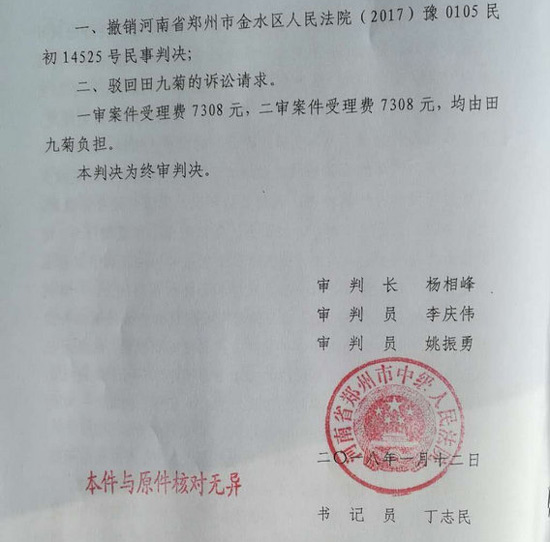
Judgment of second instance
It is indeed worthy of sympathy that the old man lost his life because of a cigarette. However, the court’s judgment should first explain the law, not see who is more pitiful, and see which side is easy to make trouble, and give a "stability judgment."
Because the judicial office faces not only the parties, but also the wider public.In fact, judicial decisions also have the function of guiding rules. If the doctor who maintains the rules "suffers", it will not only hurt his personal rights and interests, but also the expectations of the whole society.
As many netizens have questioned, if doctors are "punished" and smoke in public places in the future, who will dare to stand up?
Public opinion generally praises the rectification of the second instance of the court. There is a paragraph in the reasons for the judgment that is well written: "Making citizens who exercise their right to discourage smoking bear the responsibility of compensation will dampen the enthusiasm of citizens to safeguard social public interests according to law, which is not only harmful to social public interests, but also contrary to the legislative purpose of civil law, which is not conducive to promoting social civilization and guiding the public to jointly create a good public environment."
This is the idea that a country that advocates the rule of law should have. Of course, such a judgment is also consistent with the people’s inherent simple view of justice, which will have a subtle positive impact on guiding social justice.